
EP44 - AI Is No Longer a Choice. It Is a Risk You Have to Manage.
I want to approach AI from a different angle than I have before. My earlier takes were theoretical, sometimes one-sided. What has changed is that I am now working day-to-day in a German-speaking environment, deep in the insurance industry in Luxembourg, and the conversation looks very different from here.
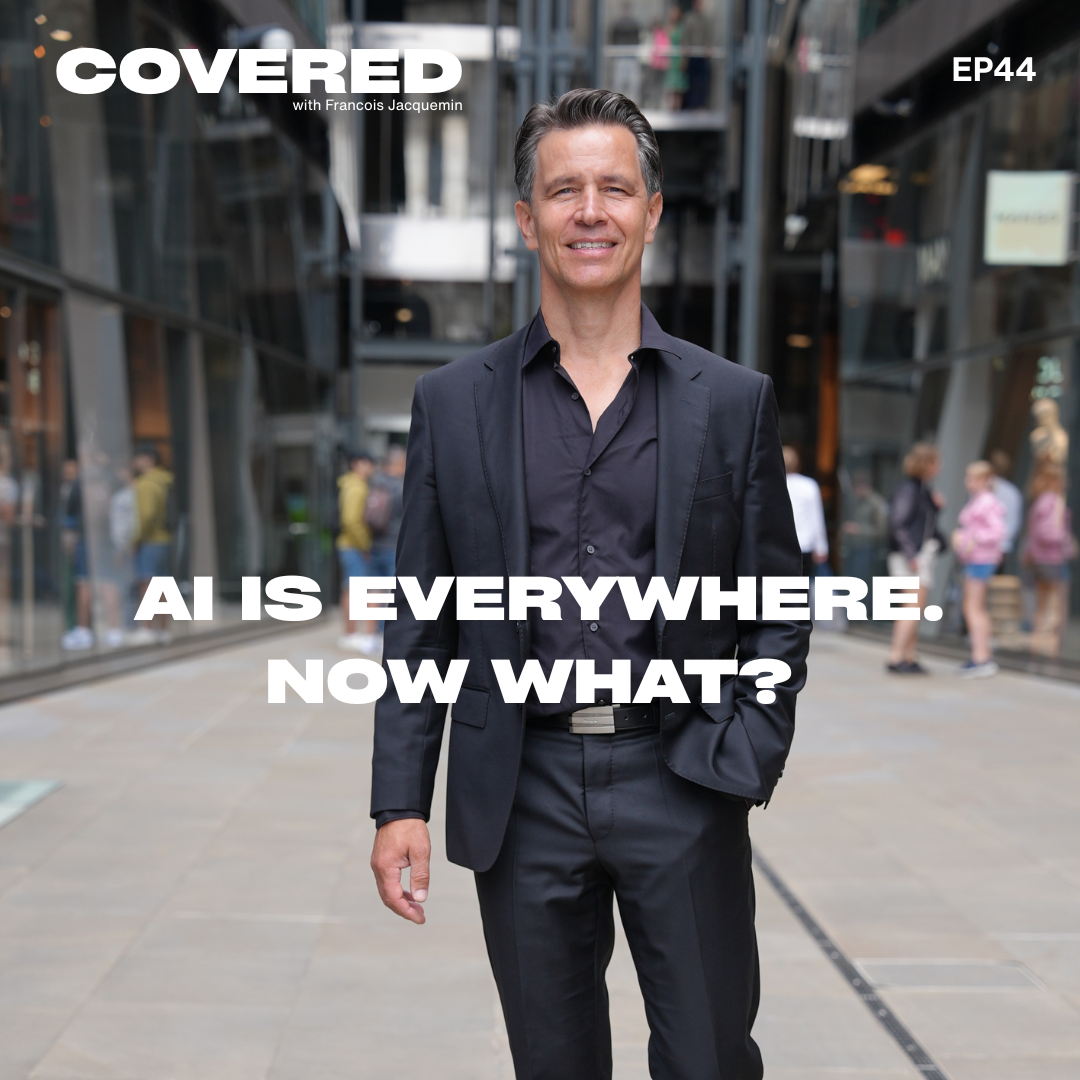
In this Episode:
François Jacquemin, international insurance executive and expert in cross-border risk structures, shares his updated perspective on artificial intelligence in business, with a particular focus on the insurance sector in Luxembourg.
This episode covers AI risk management, data confidentiality in insurance, the cost-benefit framework for AI adoption, and the role of client centricity in evaluating new technology. François draws on his direct experience operating in the German-speaking market to offer a practical, compliance-aware view of how financial services professionals should approach AI tools today.
Last year, there was still a genuine debate about whether to engage with AI at all. I do not think that debate exists anymore. Think about how quickly the internet spread, and then smartphones. I have seen marketing strategies built on the assumption that a customer has a phone and a bank account, but not necessarily a fixed address, because some people genuinely do not have one. If I described that scenario to a compliance officer in Luxembourg, I would get a red card immediately. But in those markets, it is simply how business gets done.
AI is following that same pattern. It is already inside LinkedIn's algorithm. It is inside the advertising we watch on television. It is on every smartphone. The news we consume passes through AI at some level. So the conversation has moved on. It is no longer about whether you want to use it. The question now is how you manage it, and what added value you can extract from it within the risk framework you already have.
In insurance, and particularly in Luxembourg, data confidentiality is not a compliance checkbox. It is the first thing you learn before you learn anything else about how this business works. Client data is treated with the seriousness it deserves, shaping every decision we make. So when I think about introducing any AI tool into this environment, risk is the starting point. Not efficiency, not cost savings. Risk first. What are the implications for confidentiality? What happens to your intellectual capital if the tool is not correctly managed? What are the consequences for your clients and your shareholders?
Once you have clarity on the risk, you look at the cost-benefit analysis. Does this tool actually create added value in practice for your specific business and clients? And then you look at internal competence. Do you have enough knowledge within your organization to run this responsibly, hedge risk, and actually deliver what the tool is supposed to deliver? These three elements need to align. When they do not, the tool creates exposure rather than value.
What I keep coming back to is something that existed long before AI and has not changed because of it. Client centricity. In wealth management, especially, insurance products move through a complex chain of distributors, agents, brokers, banks, asset managers, and family offices. These partners need to be convinced that what you are bringing them makes their work easier and improves the client experience. If the AI-enhanced tools you have built are generating complaints, creating confusion, or making the product harder to explain, the cost-benefit calculation goes negative very quickly. Whatever effort you put into development will not offset a poor outcome for the end client.
I have always believed that sales is about probability. Luck exists, but luck is really just another word for probability. The more you can do to increase your chances of success, the better your position. Used seriously, with a real risk framework behind it, that is what AI can do for you. Used without one, it just adds to the list of things you will need to manage.
Timecode:
00:00 Back to AI Talk
00:39 From Theory to Practice
02:14 AI Everywhere Now
03:06 Smartphone Adoption Lesson
05:03 From Choice to Strategy
05:43 Insurance Data Risks
07:20 Risk Then Value
08:44 Client Centric AI Tools
10:10 Sales Probability Boost
François Links:
Apple Podcast
Transcript:
Well, I've done a podcast in German recently, so, Jens, thank you very much for allowing me to do a podcast in, in English right now. I'm very happy. I'm going to approach the, the topic of AI again, especially since we, we discussed this topic very often last year and, the world changed since then. I changed as well, obviously. but, I just want to, to, to bring different flavors, from, from my point of view on AI, which were very theoretical before and maybe also, very much one-sided. What am I doing with AI? How can I use AI? How did I use AI? What did I develop with AI? business, developing business, developing business case, or fine-tuning business case, or doing market research, or, developing a presentation, an app, you know, or, or a marketing campaign for, for a friend, which were things that, I was doing. and there were many more things that we, we discussed at the time that were not necessarily related to, to, to the day-to-day insurance business where, where I am today. Second, I'm, I'm doing business now in a, in a different environment. I'm, I'm involved into, a, a, a totally, non- non-English or French-speaking environment, German-speaking, and, I, I speak German, so, as people can see from, other podcast. Or they will also judge me badly and say, "Well, your English is already not perfect, but your German is, my God, you know, I don't want to, to, to, to see that. Why don't you try in, in French?" okay, maybe, maybe another time. But, the point here is, yeah, we can re- I could use AI and, and, and prompt and, and make a text, using, using whatever, even, even AI producing, or an agent, asking the agent to, to produce a text for me, to introduce a level of, inconsistency and, and, and wrong, speech pattern so, it looks authentic, and use an avatar l- so, or photos and, and, and, and takes on me, and then up, o-off we go. But that's not me. But AI could do that. I mean, today you can, you can do so many things with AI, even more than last year, much more adapted, much more, let's say, even on the cognitive element, to or angle to it. So there is a lot of things that, that, that, that can happen in AI. By that I mean that the AI, AI tools have cascaded down in almost everything we do. We can say as a business, you know what, what I do is purely, non-AI because there are some confidential data risk, security risk. So many, so many risks can be listed, that would prevent, or drive companies to, to, to, to not use AI. usually not using AI is not even an option, it's just fact. Let's take a side story here. You know, we discussed about the internet, how, quickly it, took over the world. we talked about, the smartphone, how quickly, they spread in, population and, I've seen marketing strategies, during my time in a big group, that were developed, on smartphone, only. So you don't care about the address of a person because some people actually don't have an address in some countries. they have a phone. They, live here and there, or don't have a fixed address, let's say. So the business was done based on the fact that the person had a bank account and a smartphone, not an address. You know, if I tell that to my, anti-money laundering officer here in Europe, in Luxembourg, you know, and then I, get a red card. It's just not, feasible. But in some countries, actually, it's the de facto business. So going back to the point of AI, on every smartphone AI is there. Or if you want to use LinkedIn, I mean, obviously the algorithm behind it is all AI-based, or they use AI or many AI agents, many things that, that are being used there. So compared to last year where the discussion was AI, not AI, I mean, I don't think that it can be a discussion anymore. It's simply AI is there everywhere, whether you see it or not, or what you buy, the way the advert is done on television. I mean, AI is behind it, partly. But at least whatever percentage it is, we know it's not zero. The news that we get are treated with AI Everybody is using, one way or another, AI tools. So the point now is not to say, "I want it, I don't want it." It's, "How can I make the best use of it, and how can I create added value for my business using tools that are available to me? And how can I rate those tools in, the risk matrix that I have? So am I gonna use these tools or those tools or that tool if there is a confidentiality risk, if there is a risk for my intellectual capital?" Where are the data? I mean, in Luxembourg, in insurance, data are so critical. Confidentiality is the norm, and although there is a lot of... We, we don't talk about insurance secrecy, but the confidentiality of the data, of insurance data, is the number one thing that you know before even starting to understand insurance. In insurance business, it's an advantage, it's a disadvantage. But when you consider AI tools, then you must consider that element, because if you don't, then there will be drastic consequences for you, for your company, for your shareholders, and for your client. So the question there is, if AI is there, how can I still manag-manage my risk? By this, I mean AI has just become a fact of life, another risk, another tool, which is difficult, very clearly very difficult to assess. It's very difficult to plan the evolution, the strength of this tool, the potential, but also the risk that you, that, that you have. So you need-- It's become part of all the risk management process. It's become a norm. It's become part of policies. It's become part, or a very important part, of how you can improve your internal process, your documents, your efficiency. And at the end of the day The cost-benefit assessment is the second most important element. First is the risk Then the added value. And then the third element is how much intellectual capital competence you have in your company to make sure that you hedge the risk or nullify it if possible. And second, that you actually deliver on the added value. It shouldn't be a drag. It should be a tool which is going to allow you to move forward. And the third element in that is as much as what you have on your smartphone when, you're using AI or tools that you're using are using AI. What you need to do is to make sure that when you think about it, it's simply a tool that confirms or that complies with the first two points, but also that delivers value to your client whatever you do. The value to your client is going to then make hopefully sure that your, chances of success are increasing or that your chances of keeping the client in long term is increasing. So you really have to assess what is the need of the client. Do you need all those functionalities or don't you need them? And if you need them, what is the goal? Is that the goal of functionalities that are important when you present to your distributor? If your insurance is distr-distributed by, partners, agents, brokers, banks, asset managers, family office, especially in the wealth management area. So you need to convince them that the tool that you're going to develop for the client is something that make them look good or that m-make them easily sell your product. If it's complexify, if it's too complicated, if it's not working, if there are complaint from client, then the great use you've done from AI in to develop those tools or that, to have AI in those, tools available in there will not be a positive outcome. So, you know, maybe you will not get your cost benefit, positive, but it becomes negative at the end of the day. So these are the element, the client centricity that existed much before. That's always been the key element. Do you make your client happy and do you make money? Should remain there. So my take on the evolution is that it percolates in all the, struts, levels of, the business and, it creates client expectation, very high client expectation You just need to find the right level of, usage to, ensure that you meet the client expectation in the short and long term. And, then you become successful. Sales is about, we say sometimes a bit luck, but luck is about probability, and the more you increase your probability of success using AI, then that's a good use of AI