
For most of my professional life, I have expressed ideas through structure. Through presentations, written reports, or carefully drafted notes. That approach has its place. It brings clarity. It creates alignment. But it also creates distance.
In this Episode:
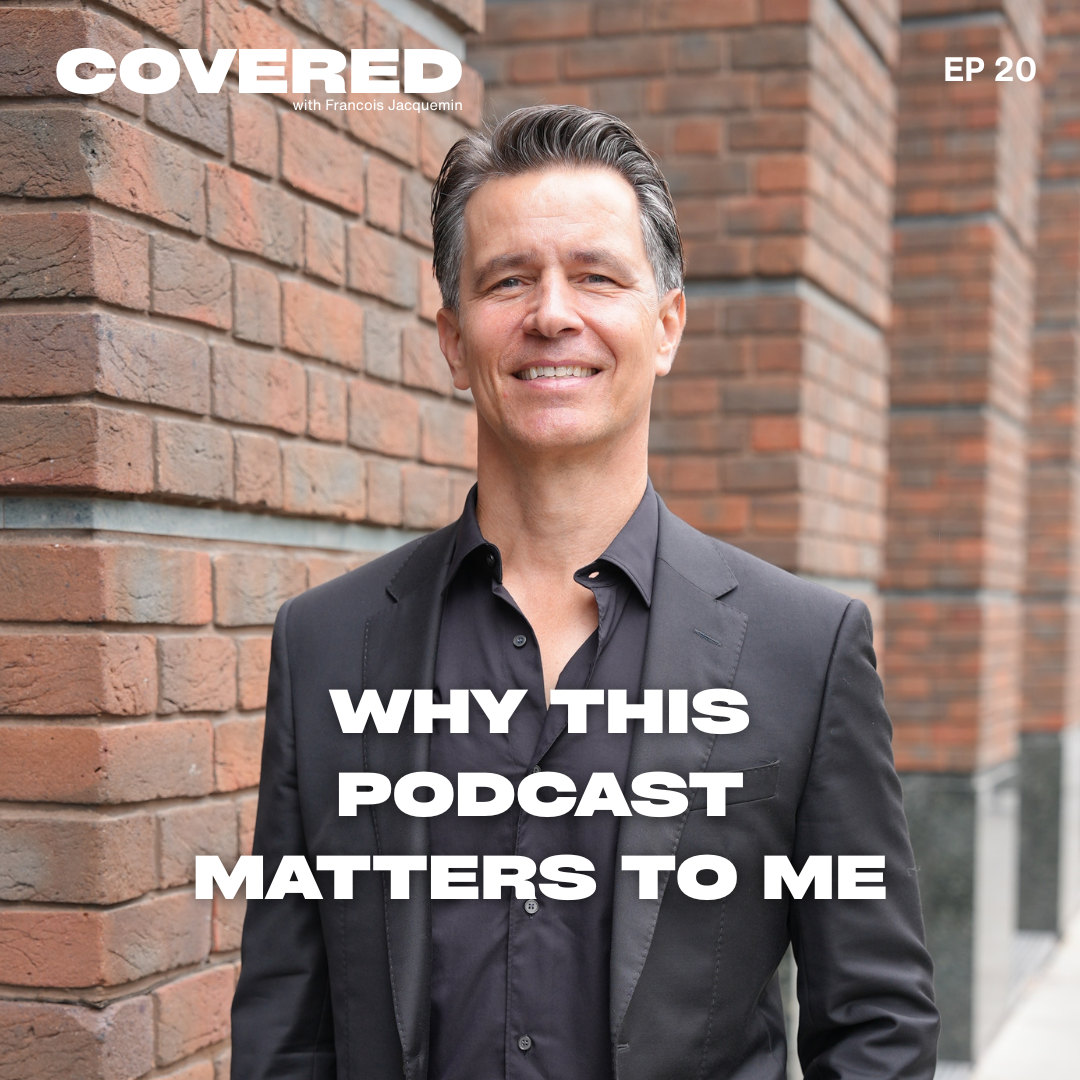
Francois Jacquemin shares the personal reasons behind launching his podcast, Covered, a space for honest reflection, learning, and leadership without filters.
When I decided to launch Covered, I wanted to bridge that distance.
Not to add another format to the noise, but to build a medium where ideas could breathe, where tone, intent, and sincerity could be heard, not just read.
A medium that fits the message.
Writing is a discipline I admire, but it often polishes away emotion.
A podcast, by contrast, captures energy in real time.
The pauses, hesitations, and tone of voice all carry meaning.
In leadership, those details matter as much as strategy itself.
When you send an email, people interpret it through their own lens.
When you speak, they hear your conviction, your doubts, your intent.
That is why I chose this format. To be heard as I am.
Not perfect, not scripted, but genuine.
From structure to presence.
This podcast is not about controversy or positioning.
It is about reflection.
It is a synthesis of almost thirty years of learning, the difficult moments, the missteps, the lessons that took time to understand.
Each episode distills one aspect of that journey.
Not to claim authority, but to contribute perspective.
To share what I have seen work, where I have failed, and how those experiences continue to shape how I lead.
The discipline of visibility.
One of my early mentors once said, “If you want to lead, you must be seen.”
At the time, I resisted the idea. Visibility felt like self-promotion.
But I have come to see it differently.
Visibility is not about being loud. It is about being accessible.
In the same way that Madonna reinvented her presence to remain relevant, an idea introduced to me during a leadership program years ago, staying visible as a leader means continuing to learn, to evolve, and to engage with others openly.
Recording Covered is part of that process.
It reminds me that communication is a living skill.
Every conversation is a chance to refine how I connect.
A record of learning.
This project, above all, is a personal exercise in consistency.
It documents how I think, how I change, and what I continue to learn.
It is as much for me as it is for those who listen.
If something in it helps another leader see their own challenges with a bit more clarity, then it has served its purpose.
That is why this podcast matters to me.
Because leadership is not only about decisions.
It is also about the courage to share the journey as it unfolds.
Timecode:
00:00 Introduction: Why This Podcast?
00:06 The Appeal of Podcasting Over Writing
01:13 The Importance of Genuine Communication
01:49 Sharing Knowledge and Experience
02:55 Learning from Industry Leaders
04:53 The Influence of Inspirational Figures
06:34 Personal Growth Through Podcasting
07:11 Conclusion: The Journey Ahead
Francois Links:
Apple Podcast
Transcript:
Why do I do this podcast? Well, let's first, um, talk about the mean, the media. So why a podcast? Normally, um, people go into books or writing, but I thought it was much more adapted to my own personality to do a podcast. Um, I like tech. Uh, I like being seen and I, I like sharing, uh, with a bit more improvisation than what I usually.
Would do if I was writing a text. And when I'm writing a text, just gathering ideas. And the same for presentations. I never can write a presentation, um, easily. I need to just put lots of ideas and start structuring them and, and then put something, uh, in, in order and create a storyline, which, um, has it, it is really nice because it's structured, it looks polished, but, um.
I thought it was better to, uh, to share to, uh, to, to, to have preparation time, but also improvisation time so that I can, I can be seen like I am and, uh, and, and, and not in a, in a, in a wrong or different way. Just an example, when you send an email to somebody, usually the email is badly understood. While in the beginning it was, uh, based on good intention, and I just wanted to avoid that.
Here when it's on, on the podcast and in a video, we can hear my voice. Uh, we can, you know, I can be seen and it's more genuine and I would hope that, uh, what I'm saying is better and clearly, uh, understood. One of the, the tone I wanted to have, I'm not doing podcast because I want. To, to criticize. I want to, to appear as controversial.
What my plan is, is to be able to share what I've learned to demonstrate, um, the hard work that I've put into learning what, what I've learned. Because, uh, maybe on a podcast on five minutes, it looks easy, but, uh, over a career of, uh, almost 30 years, uh, there was a lot of, uh, very, very difficult moment. Um, and, uh, the podcast is the synthesis of those, uh, difficult moments that I try to put, uh, in, in a positive and honest and, and and transparent fact-based way as opposed to, um, being over controversial.
However, I'm still going to address. Element of my career and the industry, uh, that I'm working in, or, um, element, uh, that, that I've encountered in my career, that could be somehow controversial. But the point is, is not to create the controversy. The point is, is to explain, uh, my views on those points and my take on how to, to, to go across, uh, some, some, some challenges that I faced when.
I was, uh, learning in England. Uh, I've done an an BA there when I was, uh, actually I had no experience, so it was after my studies. And, uh, so I was very fresh, so maybe, maybe it was too early, but still I've done it because I wanted to go into into business. And one of the things that I've learned then is, um, is, uh, reading those books from, um, Porter or Burg, or Strategy of course, but not only them, but I always thought that those books were so well written.
There was so much. Um, it was, it was an ideal, it was almost like a, a, you know, ethereal or something that, that was surreal, that somebody would just write a, a, a book out of nothing. And of, and of course I was, I was dreaming a bit, but I knew that there was a lot of work, a lot of research, a lot of experience that those, uh, great thinker, uh, had to, to, to put into, uh, into those books.
But it's something that I always, uh, was, was dreaming about. I was not. Just reading the book for what it was, but trying to understand the, the full context of it. And, um, it's, it's an element that is very important for me also, that, that drove me into, uh, willing, willing to share. Um, what, what what I've learned is, is simply because there, there's a lot of things that, that have happened and creating a synthesis and, and putting this into a, a podcast and, and maybe later in, in some written forms, uh, was something that was, that was appealing to me.
Of course. The, the willingness to share is also, it is also important. And I'm not doing a podcast because, uh, I want to stay, to stay hidden. I, I do this podcast because there's something that I, I, I have in me, uh, in, in thewillingness to, to share with, with others, and, and, and creating. Um, a community or, or, or putting bridges?
I, I, I would be modest about that, but if there's something that somebody can take, take out of, of what I'm, I'm saying it's, it's also, it's also, uh, it's also great. Why sharing when, when I was, uh, in, in a big German insurance group, um, I, I was in the, um, high potential leadership development program and, and one of the.
The, the teacher or the coach, there was, uh, Jamie Anderson. He's a, he is an Australian, uh, guy who's a business thinker. And, um, he, uh, was somehow provocative in the way he was writing case studies. And one of the case study he, he wrote was about, uh, was about Madonna or why, you know, know. Why Mada? You know, we talk about business.
Uh, Mada was actually a CEO, uh, and, and she was simply a, a dancer, and then she wanted to be in the front line. So she, she, she navigated, uh, the, the industry of, of singing and dancing to put herself into the front line to be the, the lead singer. But if you look at her throughout her career, she has always.
Put ourself forward, whether it's singing, whether it's a controversy, whether it's a book or photos, et cetera. There was always activity and the willingness of that person to stay in the spotlight, to be to, to remain relevant, to keep in. To keep on learning as well. Uh, it was not al always in front of, uh, the camera and, and, and the media, but there was also a lot of hard work behind the scene that, that were done, uh, by, by her and her team career.
If you want to, to make yourself relevant, then it was also important to to be, to be seen and to be visible. And this exercise, uh, for me in, uh, in a podcast, it's not only to be relevant, it is also a very strong, uh. Uh, personal journey that I've have undertaken. Of course, I, I like speaking, I like being in, in front of an audience, but it's not necessarily so natural.
Maybe it appears so, or maybe it doesn't. I don't know. You'd be the judge of that. But the key there is that for me. It's, uh, it's always a journey. I need to prepare. I need to be emotionally prepared. I need to have my content, I need to, to be able to, um, improvise and, um, it, it's something that I, I've undertaken.
Much more for myself than, than for, for the audience. I thought it was, it was time after having put this podcast or this, this, this sharing, um, in, in the back of my head, uh, for, for a long time. Uh, I had the mental space and, uh, maybe the maturity, uh, to, to, to start, uh, this journey. Um, which will certainly help me.
To be consistent and to record how I was thinking at some point, what I've learned, and to be able to go back to it and to keep on improving as a, as a manager, as a leader, um, as a, as a mentor, or as a, as a colleague.