
EP42 - Why I Changed My Mind on Regulation
A few years ago, I stood at a roundtable in Prague and made no secret of finding the regulatory burden on the insurance industry excessive. It was a conference I had attended before, and at that point in my career, I was deep in the middle of implementing frameworks that felt more like obstacles than enablers. My position was not entirely wrong. But it was incomplete, and my view has sharpened since then.
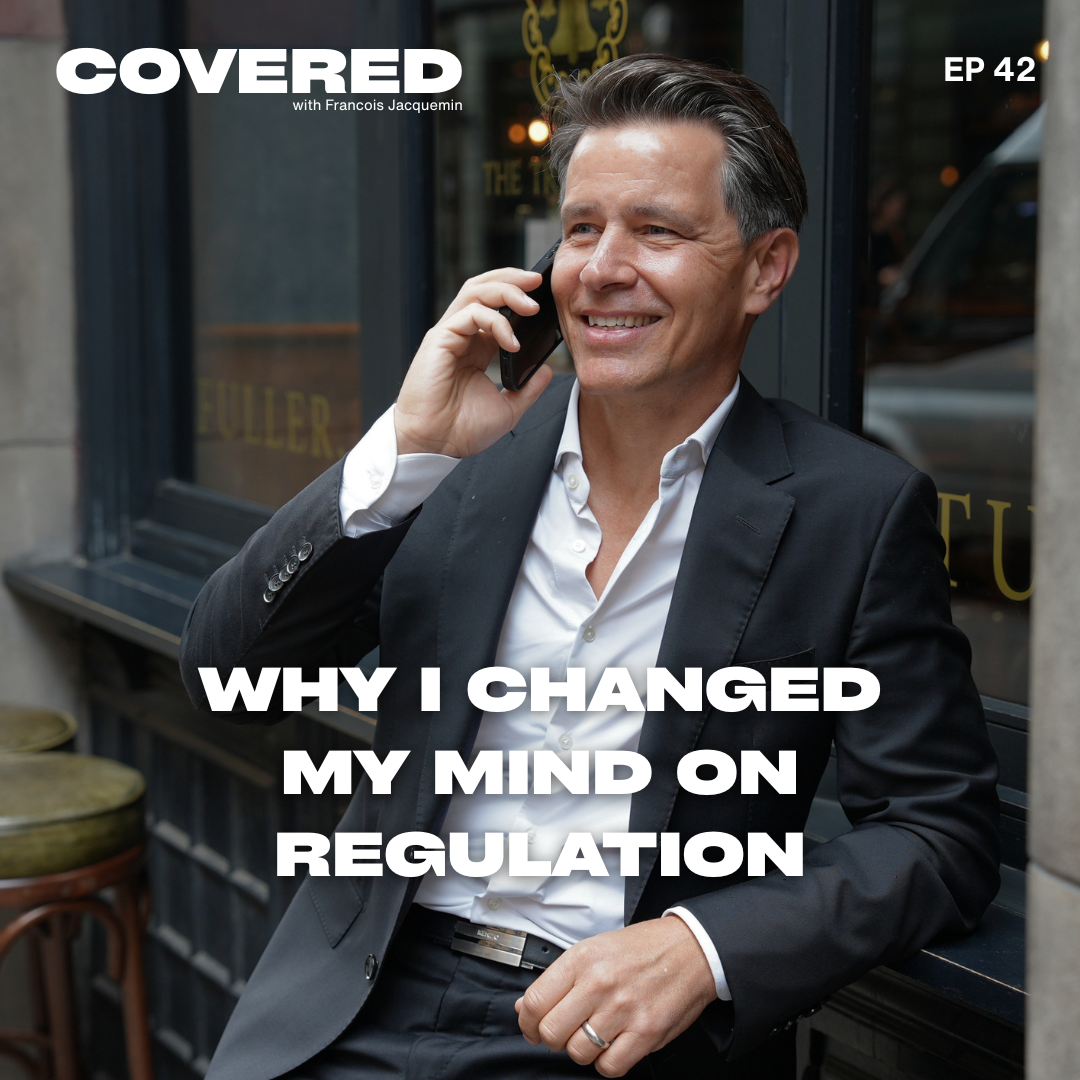
In this Episode:
Francois Jacquemin on why regulation in insurance carries more strategic value than most executives recognize, and what clarity about legislation actually means for international business execution.
The Strategy Sitting Inside the Regulation
Start with a simple thought experiment. A management team building a company strategy defines a direction, a North Star, and aligns the organization around a shared objective. They establish a focus, a direction, and commit to not going left or right or backward, hopefully. They create process norms, a framework that tells everyone how decisions are expected to be made, how resources get directed, how to stay on course.
That entire discipline is already regulation. The word carries an institutional weight we do not usually assign to internal strategy work, but the function is identical. You are defining boundaries, enforcing standards, and creating conditions under which people can operate with less uncertainty. The methodology used to build a strategy is itself a regulatory methodology.
Once I took that angle, my view on external regulation shifted. And although in the past I have already said that it is very good to know the rules so that we can play by the rules, here I would go even further than that. We are not just subject to those rules. We are also, in a sense, demanding them.
What a Well-Implemented Framework Does to a Value Chain
When a new piece of legislation arrives, the instinct in most organizations is to find someone to manage it. Compliance teams, legal teams, risk functions. These are good instincts. But what I have observed over many years is that the implementation process, when done with genuine seriousness, forces a full review of the entire value chain. Every interface, every handoff, every process connecting product design to client delivery. And when you do that work with real rigor, you almost always find things worth fixing.
The client at the end of that chain does not know what regulation drove those improvements. They do not need to know about all that regulation. But if the value chain is working well, the client feels it. They trust the product. And that quality is real, even when the upstream work was expensive and disruptive.
The Stress of Change, and Why Insurance Handles It Differently
We always complain about regulation anyway, so let me be clear about this part. Regulations are expensive. They interrupt financial plans. They demand analysis before implementation, which means months of effort before any benefit appears. Management teams, even those that openly champion organizational change, can still resist regulatory change when it arrives unexpectedly. There is uncertainty, there is cost, and there is impact on short and long-term financial and sales plans. That stress is real. I am not dismissing any of it.
But what I have observed in the insurance industry is that this stress is less pronounced than in other sectors. There was a conversation in London with Neil Wirasinha about the film industry and where it differs from insurance. My sense is that the film industry is much more adverse to regulation, and would be much less prepared to receive it, analyze it, think through where to implement it, and accommodate it into financial planning. In insurance, a new regulatory requirement lands, and the reaction, while never entirely comfortable, carries a kind of institutional readiness. The processes are there. The experience is there. We are better prepared for what is coming, and that preparation has real value even if we rarely talk about it that way.
The International Dimension
My entire career has been built in international business. Country to country. Group centers to subsidiaries across multiple markets. Clients looking for multi-jurisdiction solutions. That context adds a layer of regulatory complexity that deserves direct attention.
In a single market, genuine depth is available to you over time. You learn the rules deeply, build relationships with regulators, and anticipate what is coming. In international business, that depth across every market simultaneously is simply not available. You are always a step behind the local expert in each country you enter. The complexity does not shrink because you are experienced in international work. If anything, it compounds, because you are carrying the regulatory constraints upon your own entity while simultaneously understanding the regulatory constraints upon your client and the product you are selling to them.
There is a very fine line between those two things, and although it can look blurry, it is in fact a very clear line. What legislation governs you, and what legislation governs your client. Once you have genuine clarity on where one ends and the other begins, the picture sharpens considerably. You do not need to be the expert in every jurisdiction. But the clarity must be there. And once you master that clarity, you improve your chances of success in international business very strongly.
What I Expect Going Forward
There is someone sitting in Brussels right now, or Paris, or Frankfurt, working on a regulatory concept I have never heard of that will probably reach me in two or three years. I do not know who they are. They do not know me. But the outcome of their work will eventually arrive on my desk and on the desks of every leader in this industry.
The creativity applied to regulation is as high as the creativity applied to sales, marketing, or technology. That is not going to change. What I do believe is that companies and groups in insurance are used to this. The processes are there. The stress around unexpected regulatory change is lower than in other industries. And for those of us working across borders, maintaining clarity about the regulatory environment on both sides of the client relationship is, quite simply, the key factor for success.
Timecode:
00:00 Why Regulation Matters
01:50 Strategy as Regulation
03:46 Value Chain and Customer Impact
04:38 The Real Cost of Compliance
05:31 Regulation Keeps Coming
06:43 Insurance Built for Rules
08:40 International Regulation Complexity
10:20 Clarity as Competitive Edge
François Links:
Apple Podcast
Transcript:
And today I just wanted to come back on the topic of, regulation. So, thank you very much for asking me the question and bringing the topic earlier. And, it's also reminding me, it's good, good timing actually, because a few years ago I was, I was in Prague at a conference, and, it's more or less at this time of the year.
Actually, this year it was taking, taking place this week, and I received some, nice messages from participants there that I met the years before in that conference and some other conferences. And, the first, the first session I had at, at the time, in the conference when I was, speaking in an open, on a, on a round table was, to, to talk about regulation.
I was not very, let's say, positive about the, the, the number of regulations that are upon us and, in the insurance industry. But, I think my view changed a bit since then, or at least I've sharpened my view If we, if we take regulation simply as a piece of legislation or at, at local level in, in a, in a certain country, or to do business between countries, or, when, because we're based in the EU, we have a lot of EU, and EU-related regulation.
So it's, it's very easy, to, to, to start complaining about the number of, documents and, and, and process norms and, and regulation we have to implement, and actually it is the fact in insurance industry, which is a hyper-regulated market. but if we, if we take a, a step back and start thinking about, regulation, why they are there, and, and take just like a 360 view, and I'm just going to take the three
one, 180 more about the regulation. let's think about, the, the management, of a company which, start thinking about the strategy and, define a North Star for the, the, the company, the employees, and all the stakeholders around. That's the, the, the first step of regulation. The, the North Star gives us a direction, and so that direction means that's where we're gonna go.
this is the, the, the, the focus we are going to have, and we're not going to go left or right or backwards, hopefully. so that's regulation already. The strategy itself is a regulation, or the process that we use, the method that we use to develop the strategy is a regulation. So in, in, in, in a first instance, first step into, in, in, in, establishing a strategy, we are defining best practice, which are regulations.
So my view when I, when I took that, that angle on, on regulation, my view is, is slightly different on regulation. And although in the past I've already said that it's very good to know the rules so that we can play by the rules, here I'm just going to even say further than that, we are not, subject to those rules.
We are also demanding those rules Of course, we have to put a bit of salt and pepper in all of this because too much, inconsisten-inconsistent rules is going to create, more harm than, than good, and therefore it blurs the whole reality. So if I go back to my initial statement about, the North Star, if the reality is blurred, you don't know where the North Star is and therefore you, can just start running, a bit awkward in, various direction and, that's really bad for, your business.
then when you have many regulations and, you're implementing them, what you do is you review your whole value chain. And in the value chain itself, you also establish rules, process norms that define all the steps, that also define how interfaces are, working. And when it's working really well, the client feels it.
They don't need to know about all that regulation, all those regulations. But, at the end of the day, if your value chain is working really well, then the client who at the end, see your product and feels the product, trust your product, then, is definitely, going to, experience a higher quality than if those regulations had not been there.
Um We always complain about regulation anyway. So let me, let me be very clear. All the positive I just said now, they are very constraining, they're very demanding, they cost a lot of money. They also, create a lot of frustration when we are establishing and implementing those. Well, first, before implementing them, we also have to analyze them and, and see what impact it has on us, as a, as a whole industry then, and as a, as...
on, on us as a, as a, as an insurance company wherever we're located. And based on my experience, it's never a very fun topic. But once it's implemented, then, you know, or, or in the implementation phase towards the end, then, we can start seeing the benefit of such a regulation. And, we're very happy when it's finished.
but being in a, in an industry, in, in, in a continent where regulation happened to be a strategy, a defense mechanism, then, I'm sure that, today in Brussels at this time, in Brussels, Paris, Frankfurt, or wherever in Europe, there's a gentleman or a lady thinking about a regulation, what can we do, to regulate better, to, to change something which is not, is not perfect.
And this person doesn't know me. I don't know him or her. But in two years' time or three years' time, maybe we will see the result of that thinking process that is probably going to come at some point to a, a, a project and a regulation implementing a set of law or circular letter or, or norms or, or whatever.
So, that, that's something that I expect that today's the, the, the level of regulation is, is very heavy. tomorrow is not going to change. The creativity in regulation is as high as the creativity, that we can use on the market, in sales, in marketing, in AI, with AI, without AI. So, that, that's not going to change.
That's, that's, very, very clear for me. What, I think about the insurance industry though, is, twofold. My take on that is insurers have been under regulation for a very long time, so the, company, companies, groups are used to, implementing regulation. The process are there. The, stress is not there anymore.
Like, when there's a, new regulation coming up or something unexpected, then, management and companies react very negatively, to change. I mean, management, management, although they promote change, sometimes when change come upon them, they also have, resistance to change because there's uncertainty.
it's going to cost it's going to impact the financial plans, the sales plans, short-term, long-term possibly. So there's a lot of stress that, goes with that. What I see in the insurance industry is that that stress is less there than in other industries. You remember the discussion we had with Neil in London about the, the movie industry and, and, the, the, the similarities, but also the differences.
I think the movie industry is much more adverse to regulation than, than insurance. So if they receive regulations, they will be mul- much less prepared than the insurers into, analyzing them, thinking about, where do I need to implement them, what it means, the efficiency in implementing them, the accommodation of such a regulation in the financial plan in the short and long term.
So in a hyper-regulated industry, we're just like, "Oh, another re- in, in reg- piece of regulation?" Almost that's fine. You know? We're used to it. Of course, it's, we don't react always like that, but it's just, better, we're better prepared, to what's coming. So that's, that's very good. There's also, for insurers, and what I'm going to talk about is because all my career, I've done international business, always from one country to another country, from a group center to many other countries, and, my clients were always client located somewhere and, and, and, and buying somewhere else or, willing to look for international multi-country solutions.
So in, in that environment, you don't talk about one single piece of regulation. It's not I know my market, I master my market, I know what my client wants, I talk to them, and, I know exactly, the whole constraining regulatory governance environment. In the international business, you never consider one piece of, of law.
You need to consider several pieces of legislation. And, you're never a specialist. You can be a specialist in international business, that's one thing, but wherever you go in a country, you're always a step behind those, local specialists. So you need to take a different angle, when you approach the market.
You need to take, a more holistic approach. You need to be forgiving, to yourself, and you t- need to rely also on a, a lot of feedback. But one thing is clear is that the complexity is not being less, although you're a step behind. It's extra complexity. You need to understand what your constraints are upon you and the constraints about, upon y- y- the sales and, and, and your client or the product that you sell to your client.
Um There's a very fine line between the, the, the wh- where you are and, and, and the legislation upon you and where you sell the re- legislation about the-- your client. So-- And although it looks blurry, but it's very clear the step, the steps of what is legislation of one p- the, the one, one part is and, and the other part is.
If you, if you know that, if, if you, if you, if you master that, then the international business that you bring, wh- what you offer to your client is, of higher qual- quality, and there is no blurry element here. It's very clear. And in international business, clarity about regulation, clarity about the regulation that's upon you and upon your client is, the key factor for success.
If you master that, the clarity, you don't need to be the expert, but the clarity must be there. Once you master that, as I said, then you have, improve very strongly your chances of success.