
EP35 - The Future of Insurance Distribution Is Not Digital Only
When people ask me what insurance distribution will look like in 2030, they often expect a definitive answer. Fully automated. Fully online. Fully driven by artificial intelligence.
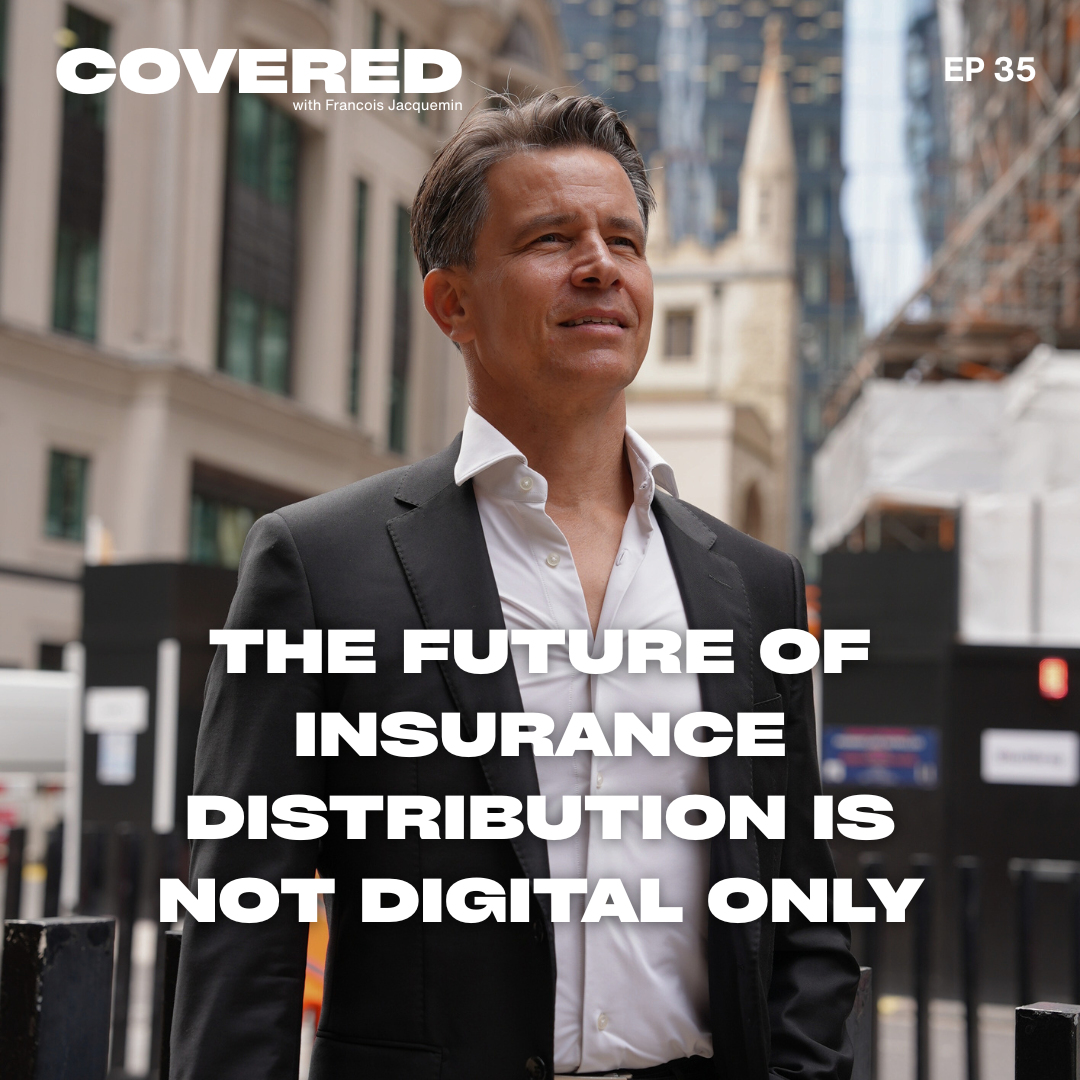
In this Episode:
Francois shares why insurance distribution in 2030 will not be fully digital. A clear perspective on AI, human advice, and the future of client trust in insurance and reinsurance.
I do not share that view.
Not because I underestimate technology, but because I understand the nature of insurance.
What lies ahead is not a clean break from the past. It is a gradual, disciplined evolution. One that blends digital intelligence with human responsibility.
Evolution Over Revolution
Insurance has always evolved under constraint. Regulation, fiduciary duty, and long-term promises shape how products are sold and serviced. These forces do not disappear with technology. They adapt.
AI already enhances nearly every step of the value chain. Marketing becomes more precise. Sales processes become smoother. Claims handling becomes faster and more accurate. This progress is real and measurable.
Yet even today, in some of the most digitally advanced European markets, only a small share of insurance sales is completed entirely online. The majority still flows through brokers, agents, banks, and embedded partnerships.
That balance will shift. Digital channels will grow. But they will not eliminate human distribution.
How Clients Actually Behave
Most clients no longer approach insurance unthinkingly. Seventy to eighty percent of people research online before making a decision. They read. They compare. They consult AI tools. They seek multiple perspectives.
This is healthy behavior.
But research is not decision-making.
As complexity increases, clients begin to question their own understanding. They ask whether what they have read is sufficient. They wonder if essential details are missing. They seek confirmation.
At that moment, independent advice becomes a shortcut to clarity. Not because clients are incapable, but because time, confidence, and accountability matter.
Very few people wake up eager to analyze policy wording in depth, especially when it concerns their own risk. Even experienced professionals rely on trusted guidance when personal exposure is involved.
The Role of Human Advice
Human interaction in insurance is not about replacing information. It is about interpretation.
A skilled advisor contextualizes risk. They simplify without distorting. They assume responsibility for explaining consequences. They help clients feel a sense of ownership over their decisions.
This role becomes more important, not less, as digital tools multiply options.
The future will favor advisors who work with digital platforms, not against them. Those who understand data, leverage AI insights, and still bring judgment, ethics, and empathy to the conversation.
AI With Purpose
Insurers and distributors are investing heavily in AI. Not because it is fashionable, but because it delivers tangible outcomes. Efficiency. Retention. Accuracy. Profitability.
The same applies across the ecosystem. Brokers, MGAs, fintechs, and service providers all compete to improve their position through technology.
This competition fuels creativity. Not all ideas succeed. Many tools fail to convince clients or decision makers. But collectively, they push the industry toward greater agility, transparency, and client centricity.
What matters is discipline. AI initiatives must be tied to clear business objectives. Technology without purpose creates noise, not value.
A Hybrid Future
By 2030, insurance distribution will be deeply hybrid.
Digital journeys will handle simplicity and scale. Human expertise will address complexity and consequence. Clients will move fluidly between both, often without noticing the transition.
This is not a compromise. It is an optimization.
The future of insurance is not about choosing between humans and machines. It is about designing collaboration that respects both efficiency and trust.
Insurance has always been a promise about the future. That promise still requires a human face.
Timecode:
00:00 Future of Insurance in 2030
00:10 The Role of AI in Insurance Sales
00:36 Current Sales Process and Its Evolution
01:16 Online vs. Traditional Insurance Distribution
01:55 Integration of Digital and Human Interaction
02:27 Consumer Behavior and External Advice
05:34 Importance of AI for Insurance Companies
06:23 Competition and Innovation in the Insurance Industry
08:00 Conclusion: The Hybrid Future of Insurance
François Links:
Apple Podcast
Transcript:
So what will it look like in five years, let's say in 2030, selling insurance to clients? I guarantee you it's not going to be, despite the AI revolution and everything it can bring in optimization, efficiency, and creating availability and transparency for the client, it will not be online only, and it will not be AI only selling insurance to clients.
Of course, it’s going to be something different than today. It's going to be an evolution, not a revolution. The way I see this is, regulation of course requires certain elements and things to be done in the course of the sales process. The sales process could start much earlier than the actual touch point with the client the promotion, ads, all the marketing and then the sales per se. Then, at the moment of truth afterwards, at the moment of claim, there will be improvement by AI in every element of that value chain or sales and marketing value chain.
But only part of the population today basically it's 10% of the sales in Europe, we can say. Depending on each country, but let's say an average of up to 10% is done online. The rest is done by independent agents and brokers, whether it's small brokers, large brokers, or partnerships like embedded insurance, banks, or that type of distribution.
Those shares will shrink, I believe, a little bit, and more share will be given to the online. I see more an integration of the digital means of talking to and exchanging with a client and the human, the partnership, or the strong touch next to insurance. By strong touch, I mean that it's not only a call, a chatbot, or a video conference with an avatar, but that there will be other elements in the sales process that involve human interaction.
Of course, the young generation today is much more driven by online exchange. Regarding older generations, they are also a bit more driven after COVID than before COVID. We still like that it works, and insurance will always work online and through digital interaction when nothing's happening. So you buy a contract, you are insured, you have a bit of security, and nothing happens that's great. But then you start buying another contract, or you need to increase complexity and so on. At that moment, you will start asking yourself: Is what I read enough? Is what I see during my exchange with my avatar or my chatbot enough? Or do I need external advice? Do I need independent advice, or do I go to an agent because I want to own my contract with the same insurer?
Questions are being asked. Sometimes you even go here and there. What we see today is that 70% to 80% of the population goes on the internet, using AI or direct search themselves, to find more information about the insurance product they are going to buy. They will discuss with a person, but also have a second or third opinion using their own time and their own means. That, of course, is a trend and it will never stop.
So when I spoke about integration earlier, it was about there being more online and much more exchange using digital means, but there will be moments where an external human being will be required and will be wished for by the client. That will be due to complexity. I love reading about insurance. Every time I have developed products in the past, I was actually writing the general conditions, reading a lot of them, and so on. I like that very much. But when it's about my own insurance and my own choice of insurance, usually I don't necessarily read the whole conditions. Maybe it's because I think, "Oh, I know that type of article." I'm convinced most people don't do that. We just stay at the simple level. At the highest level, we don't usually deep dive. Of course, people in some countries deep dive a bit more in the contract, sometimes less. But let's say that it's not the wish of everyone to get up in the morning, deep dive into their insurance contract, and start comparing.
That's why external advice will always remain somehow important as a shortcut, as a summary, making it a tool to be able to make the choice of the contract or the company you are going to contract with. The point is, insurance companies invest a lot in digitalization, using data and AI, and understanding how they can best use AI. This should be done, as I mentioned earlier as well in different podcasts, on a business case basis. Insurers are not investing in AI because they find it fancy. They invest in AI because it's going to bring efficiency, better marketing, a better and more efficient sales process, more efficient client retention, quicker and more precise claim payments, etc. But there has to be a business objective when a project is approved and implemented.
Insurers are not the only ones developing AI tools and using AI to improve their position and strengthen their ability to do business and be profitable. Distribution companies, like large brokers or smaller brokerage firms, invest a lot in AI to expand their reach and expand their client base. They do the same, and they compete with insurers for the same client and for part of the profitability of the product because all that efficiency is built for the benefit, of course, of the client, but also of the stakeholders the shareholders who want a return. They invest in insurance and insurance distribution because they will make money out of this. So it's also an element that we need to take care of.
Still, there is competition between reinsurers, insurers, distributors, and FinTechs, who also want a part of the pipe because they develop a tool that could create these efficiencies. So that whole ecosystem is developing new tools and is very creative. A lot of that creativity is lost because things are not working or are not strong enough to be convincing to a client or to a business decision. But all that creativity is pushing the industry toward being much more agile, efficient, client-centric, and transparent in the way of doing business with a client.
Still, my conclusion remains: in 2030, not everything will be digital. There will be a combination of human and digital intervention, and there will be collaboration and teamwork between AI and humans to deliver better, quicker, and more transparent products to clients.