
EP37 - AI in Insurance Is No Longer a Technology Question. It Is a Governance One
For a long time, the insurance industry approached artificial intelligence as a technical challenge. Do we have the data? Do we have the tools? Do we have the skills?
In this Episode:
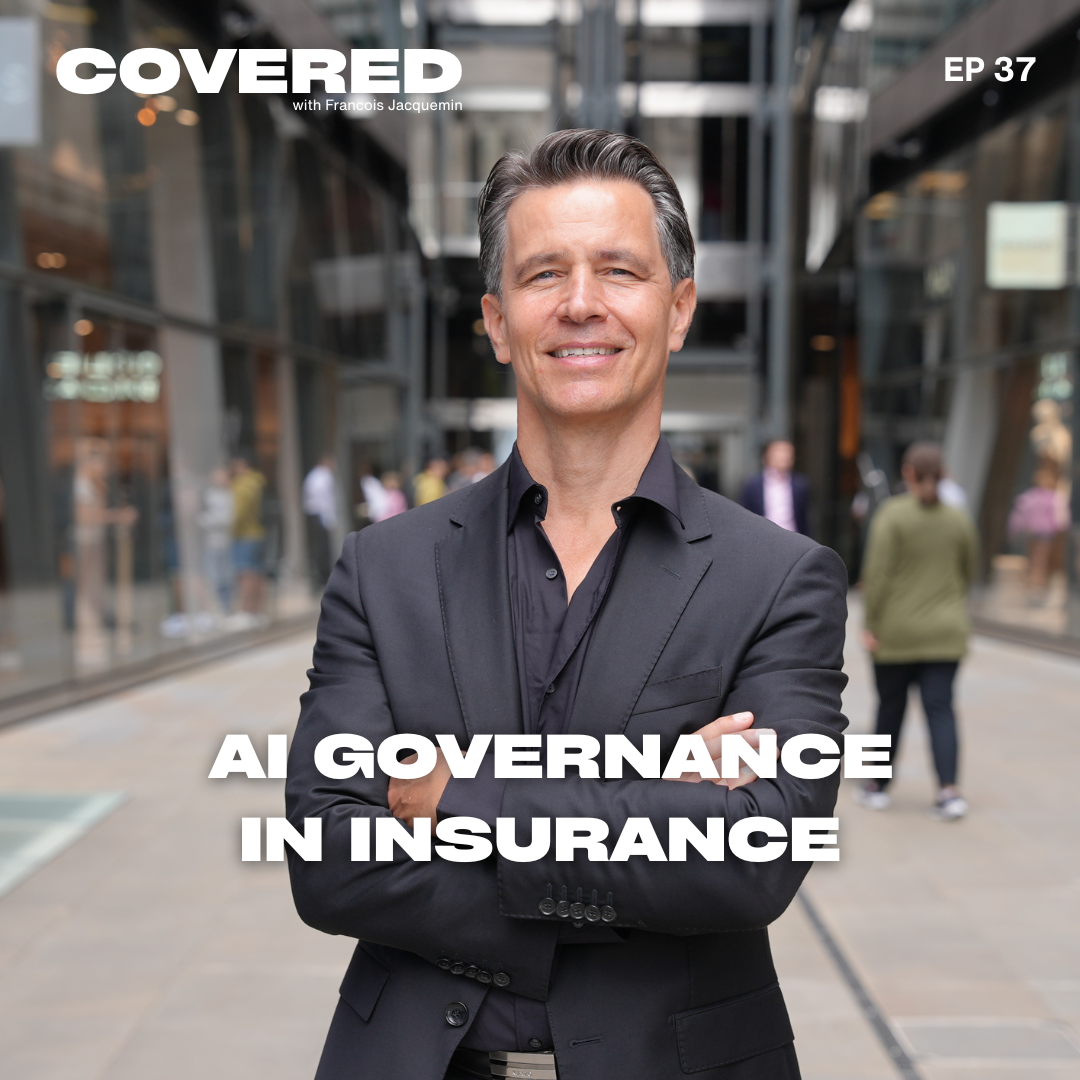
AI in insurance has moved beyond technology. Francois Jacquemin explains why governance, regulation, and board-level clarity are now the real enablers of sustainable AI adoption across insurers and reinsurers.
Those questions mattered. They still do. But they are no longer the decisive ones.
Today, the real question facing insurers is governance.
Insurance is one of the most regulated industries in the world. Particularly in Europe, regulation is dense, evolving, and sometimes contradictory. This is not new. What is new is how quickly AI entered organizations without the same regulatory maturity that surrounds traditional insurance activities.
In the early days, AI initiatives were driven by experimentation. Improving underwriting accuracy. Accelerating claims handling. Enhancing customer service. Optimizing internal processes. Most of these efforts were guided by common sense and professional ethics. Data was protected. Processes were monitored. Risks were discussed.
But common sense is not governance.
As AI usage intensified, so did internal friction. What was allowed at the group level. What subsidiaries could test locally. What employees were experimenting with on their own initiative. The lack of shared rules created confusion, frustration, and sometimes fear. Not because AI was dangerous, but because uncertainty is.
Boards do not fear innovation. They fear blind spots.
What we are seeing now is the gradual arrival of regulatory frameworks that integrate AI into broader digital and insurance regulation. In many cases, this is welcome. Not because more rules are inherently good, but because clarity creates confidence.
Clear governance pacifies internal debate. It gives executives and boards a framework to discuss AI rationally, without emotion or exaggeration. It allows organizations to allocate budget and time deliberately, rather than defensively. It also anchors AI initiatives in long term sustainability rather than short term excitement.
There is a cost, of course. Governance requires discipline. Documentation. Oversight. Time. But the alternative is worse. Fragmentation. Inconsistent decisions. Solutions that cannot be scaled because someone critical feels exposed or unheard.
One principle matters more than any regulation. If a key stakeholder is not comfortable with an AI solution, it should not be implemented as is. It should be reviewed, adapted, or postponed. Prudence is not weakness. In insurance, it is professionalism.
We are now entering a more mature phase. After years of learning and experimenting, the industry has a clearer understanding of what AI can and cannot do. That maturity must be reflected in governance that is intelligent, proportionate, and evolutionary.
My concern is not the regulation itself. It is an accumulation. If legislation becomes a pile of overlapping rules and circulars, we risk creating a burden that defeats the very purpose of AI. Efficiency. Better service. Better decisions.
The responsibility lies with all of us. Insurers, regulators, boards, and executives. Governance must evolve thoughtfully, not mechanically. Gradually, not reactively.
AI will reshape insurance. But governance will determine whether it strengthens trust or erodes it. The future does not belong to the fastest adopters. It belongs to the most disciplined ones.
Timecode:
00:00 Introduction to AI in Insurance
00:46 Regulatory Challenges and Investments
02:31 Internal Debates and Governance
03:18 Welcoming Regulation for Clarity
05:25 Future of AI Regulation
François Links:
Apple Podcast
Transcript:
So, yeah, we talked a lot about AI during the podcast, and there's a very strong element that impacts the use of AI by insurance companies: the governance aspect. The insurance industry is always a highly regulated industry in some countries more than others. But it's constant, especially in Europe, that the regulation upon insurers is increasing and sometimes conflicting.
AI, on the other hand, was at the beginning not so regulated, and maybe not so much still today. However, insurers have been investing so much in tech and so much in AI that there has been a bit of a gray zone existing. At the beginning, it was more from the insurance point of view to explore the use of AI, whether it's something that is being used as an improvement tool for the value chain, for the client services to create efficiency, or to optimize the use of data.
There was, of course, a lot of common sense that was being used by insurers to protect the data, the information, and the process that the insurers had, and they were governed by the regulation upon the insurance in their home country or in other countries for some of the contracts; therefore, there was a lot of caution used there. The regulation and the governance that were being developed were a demand, I would expect, from the insurance point of view from the board and from the insurers themselves because when we have a project or a pilot, a proof of concept that we would like to pay for, we don't want to do something which is outside the scope of regulation today, or what we would expect is the scope of the regulation in the future.
The more intensified the use of AI and AI tools was, the more it was necessary for having internal regulation. There were lots of debates internally between insurers in countries or within insurance groups to know what is allowed, what is not allowed, what employees were doing, and what companies or subsidiaries were doing versus the group and so on. There was a lot of debate, a lot of contradicting information, a lot of frustration, fear, and misunderstanding.
The fact that regulation has been developed and is coming now to the market but basically it's coming upon insurance companies and has been integrated into all digital regulations and pieces of law or circular letters, is something which, although normally I would say too much regulation is not good, in this instance is something which I would say is strongly welcome to give guidelines and to give a framework for insurers to know what to do. It's something which would really pacify the debate inside companies. It would probably put a bit of requirement on budget and time allocated to creating the right process and the right governance, but certainly, in the long term in terms of sustainability of the usage of AI, it is strongly welcome.
From the board's point of view, I would expect as well that board members and the managers of companies feel much more at ease in terms of discussions and debating on the usage of AI whether directly, whether it's for internal use, or in relationship to clients, or in all the service providers that are used by insurers and the distributors. It's something which can create the right level of understanding, the right level of debate, and the ability to drive and define solutions which are acceptable to all, as opposed to being too challenging. It's a solution that would not have been developed with the right mindset, although digitally, technically, actuarially, or legally it could have driven some fear towards part of the stakeholders. In those instances, the prudential approach would be that if one of the key stakeholders doesn't feel comfortable with the situation, the solution should not be implemented or should be reviewed or scaled down.
Now is the right time where, after learning and experimenting, insurers and all the members of the ecosystem start having a clear understanding of the scope of the development and what is possible to do. There is what we would say in French a "bémol" to this, in that the regulation that's been developed now may not be the most up to date, and the implementation will still take the whole ecosystem a while. The fear I have is that if the evolution of the legislation is simply piling up pieces of law and circular letters on top of each other, then it's going to become a gigantic pain for all the ecosystem.
The discipline that we should have in further developing our own governance as the insurers, exchanging with the legal and legislation elements in a country or in Europe, would be to keep on being intelligent and making things evolve gradually rather than just creating a burden for insurers which is counterproductive especially since AI is supposed to improve dramatically the efficiency, client services, and the ability for insurers to innovate.